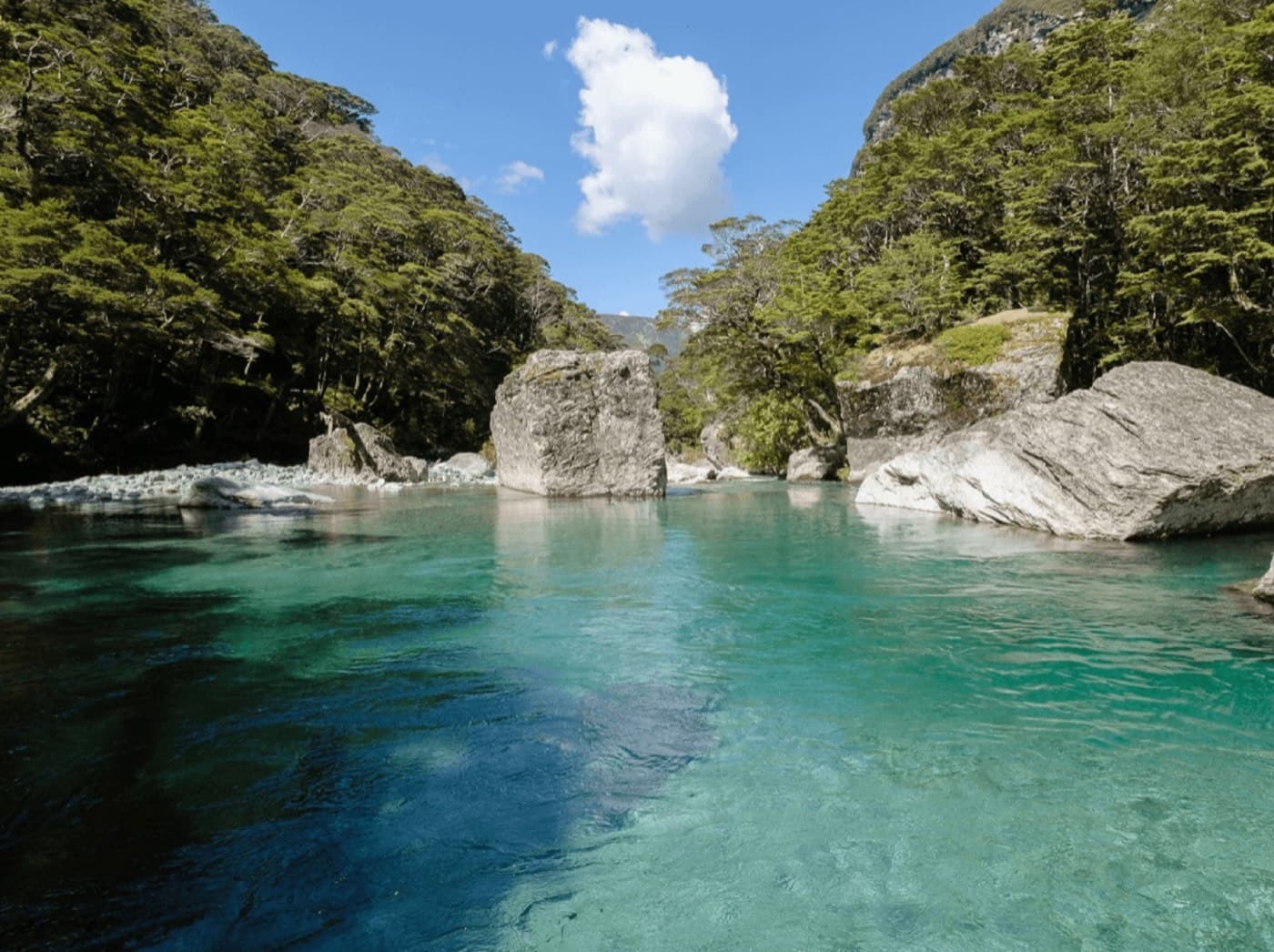
The Blue Spring at Putaruru is one of those places that looks edited. The water is so clear that the weed on the bottom appears to be floating in air, and it holds a blue that does not photograph quite the way it looks.
It is a genuinely easy stop, and it is also the one people most often get wrong, usually by parking at the wrong end and committing to a much longer walk than they intended. Here is how it works.
Why the water looks like that
Rain falling on the Mamaku Plateau filters down through porous volcanic rock, and by the time it emerges at the spring it has been underground for somewhere between fifty and a hundred years. The rock strips out sediment and the result is water of exceptional clarity and purity.
It comes out at a near constant eleven degrees Celsius year round, at a rate high enough that the spring supplies a large share of New Zealand's bottled water. The blue is a trick of that clarity and depth rather than anything in the water itself.
Which car park to use
This is the part that matters. There are two access points and they give you completely different days.
Leslie Road: the short way
Just over a kilometre to the spring viewing platform, around 30 to 40 minutes return on a flat, well formed gravel path. This is the one you want if the spring is your goal.
Whites Road: the long way
Roughly 4.7 kilometres one way, about 90 minutes each way, following the Waihou River the whole distance. A lovely walk, but a serious commitment if you assumed it was a ten minute stroll.
- For most visitors and anyone short on time: Leslie Road
- For a proper riverside walk with the spring as the payoff: Whites Road
- Both car parks are free, neither has much shade
Why you cannot swim in it
Swimming and any contact with the water has been prohibited since 2016. The spring feeds a drinking water supply, and the volume of visitors was damaging the banks and the aquatic weed beds that make it look the way it does.
It is well signposted and it is enforced. Come to look, not to get in. There are plenty of swimming spots in the Waikato that will not cost a water supply its clarity.
The best time to visit
Late morning to early afternoon, when the sun is high enough to reach down into the water, gives you the strongest colour. Overcast days flatten it considerably.
The walkway is busiest on weekends and through summer. Early on a weekday morning you may have the platform to yourself, though the light will be softer.
- Best colour: late morning to early afternoon on a clear day
- Fewest people: weekday mornings, or outside the summer holidays
- The path is exposed, take a hat in summer
- Sturdy shoes if it has rained, the gravel gets slick in places
What to combine it with
The Blue Spring is short enough that it needs company to make a day. It sits conveniently between several of the better stops in the eastern Waikato.
Our half day tour pairs it with Sanctuary Mountain Maungatautari, the largest predator free fenced sanctuary in the country, and finishes with a soak at Okoroire Hot Springs. Lunch is included and the tour runs $695.
- Sanctuary Mountain Maungatautari and its 18 metre canopy tower
- Okoroire Hot Springs and the 1889 heritage hotel
- Tirau, ten minutes up the road, for cafes and the iron sculptures
- The Hobbiton Movie Set at Matamata, half an hour away